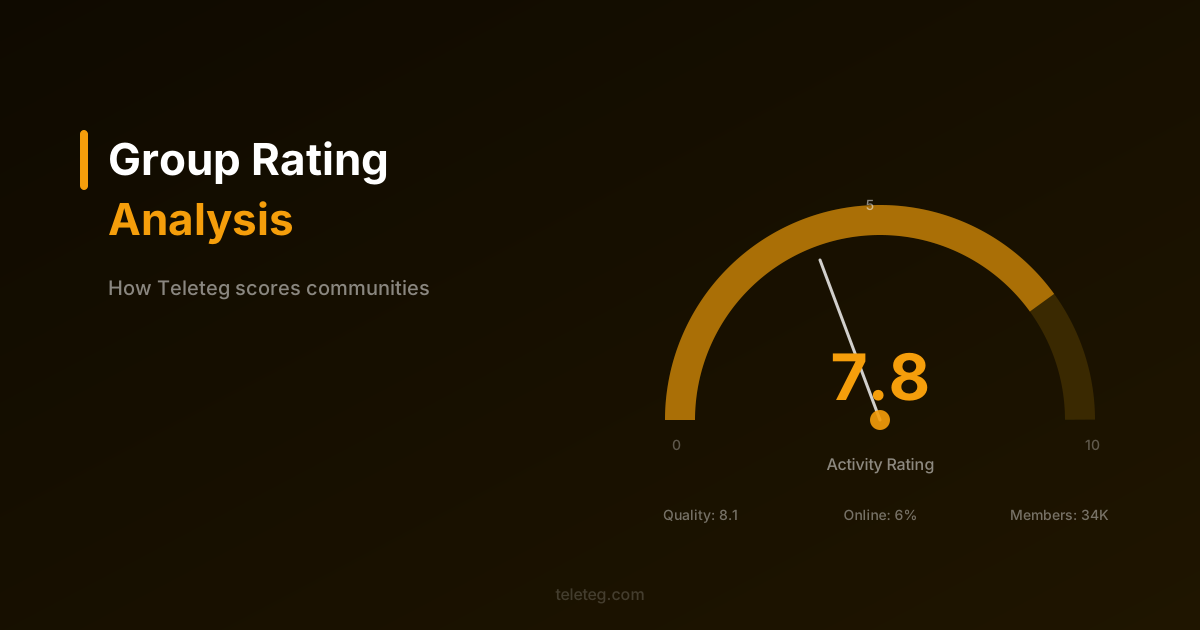
Not all Telegram groups are equal — and the difference between an active, high-quality community and a dormant or low-value one isn't always visible from member count alone. Teleteg's group rating algorithm was built to surface that difference in a form that's immediately useful for search and filtering.
Teleteg is a public Telegram search engine indexing millions of public channels and groups. This article is part of our knowledge base on Telegram search and community discovery.
Why Member Count Alone Is Misleading
A group with 100,000 members sounds significant. But if those members joined over several years, most have muted notifications, the last substantive discussion was months ago, and the admin hasn't posted in weeks — the actual value of that community for any research, engagement, or analysis purpose is close to zero.
Conversely, a group with 3,000 members that posts daily, generates real replies, and has an admin who's actively present is a genuinely valuable community — often more so than groups ten times its size.
Member count is easy to inflate and easy to misread. Activity and quality are harder to fake and more predictive of actual value.
What the Rating Algorithm Measures
Teleteg's group rating is a composite score built from several signals:
Posting frequency. How often does the group produce new content? This is the most basic activity signal — a group that hasn't seen a new message in weeks is effectively inactive regardless of its member count.
Message quality index. Not all messages are equal. A group where members post substantive questions, detailed responses, and relevant information scores differently from one where activity consists mainly of one-line reactions, stickers, and automated bot posts. The quality index attempts to distinguish these patterns.
Online ratio. The percentage of members who are online at a given time is a proxy for genuine engagement. Groups with high member counts but very low online ratios often have significant proportions of inactive or automated accounts.
Engagement patterns. Reply chains, reactions to specific posts, and the distribution of participation across members (as opposed to a handful of very active users and a silent majority) all contribute to the overall rating.
How to Use the Rating in Practice
The rating is most useful as a filter rather than an absolute ranking. Setting a minimum rating threshold in a Teleteg search immediately removes the long tail of inactive and low-quality groups from results, leaving a more manageable shortlist of communities worth investigating further.
For comparative analysis — understanding how groups in a specific niche relate to each other — sorting by rating gives a useful starting picture of the quality hierarchy within that topic area.
The rating is less useful for comparing groups across very different topics or languages, since baseline activity levels vary significantly between communities. A highly rated group in a niche topic may have lower absolute activity than a moderately rated group in a high-volume topic — the rating reflects relative quality within context rather than absolute message volume.
Limitations Worth Knowing
No automated rating system perfectly captures community quality. Groups with highly engaged niche audiences sometimes score lower than large general-purpose groups simply because their topic generates less frequent but more considered discussion. The rating is a signal, not a verdict — it narrows the field, but evaluating the top results still benefits from a quick manual review.
Ratings are updated regularly as new data is indexed. A group that went inactive recently may still show a historically high rating until the index refreshes. Checking the creation date and recent activity alongside the rating gives a more complete picture.
Finding High-Quality Groups
To search by rating on Teleteg, set a minimum activity rating in the search filters. Combined with language and topic keyword, this surfaces the most active, substantive communities in any niche. The search tools guide covers how each metric is defined and how to combine filters effectively.