Teleteg is a public Telegram search engine indexing millions of public channels and groups. This article is part of our knowledge base on Telegram search and community discovery.
Building anything that involves searching Telegram programmatically means choosing between three fundamentally different approaches. Each has a different scope, different constraints, and a different implementation cost. Understanding the trade-offs upfront saves significant time.
The Core Problem: Telegram Has No Public Search API
Telegram does not offer a public, documented search API in the conventional sense. There is no endpoint you can call with a keyword and get back a ranked list of public channels and groups. The search functionality that exists is either user-facing (native app search), user-session-based (MTProto API), or purpose-specific (Bot API inline queries).
This is why third-party indexed services exist — they fill the gap that Telegram's own infrastructure does not.
Option 1: Bot API Inline Queries
The Bot API's answerInlineQuery method lets a bot respond to inline search queries from users. When someone types @yourbotname keyword in any Telegram chat, the bot receives that query and returns results — articles, links, media, structured cards.
What this is good for: building a search bot that queries your own data and surfaces it inside Telegram. Examples: a documentation search bot, a product catalogue, a FAQ bot.
What this cannot do: search Telegram's own index of public communities. You can only return results from data you control or have independently indexed.
Rate limits: inline query responses must arrive within a few seconds. The Bot API is well-documented and relatively stable — a reasonable starting point for most bot-based search use cases.
Option 2: MTProto API
MTProto is the underlying protocol Telegram's own clients use. It provides access to methods that the Bot API does not expose, including contacts.search (search by username or name) and messages.searchGlobal (search public content by keyword).
What this is good for: programmatic access to Telegram search results that approximate what the native app returns. Useful for monitoring specific usernames, tracking how keywords surface in public content, or building tools that need to interact with Telegram at the protocol level.
Constraints: requires a valid Telegram account and API credentials from my.telegram.org. Rate limits are strict and enforced. Results match native search quality — limited in depth and coverage. Telegram has become more active in restricting accounts that exhibit automated patterns, so staying within documented behaviour is important.
Option 3: Third-Party Indexed Services
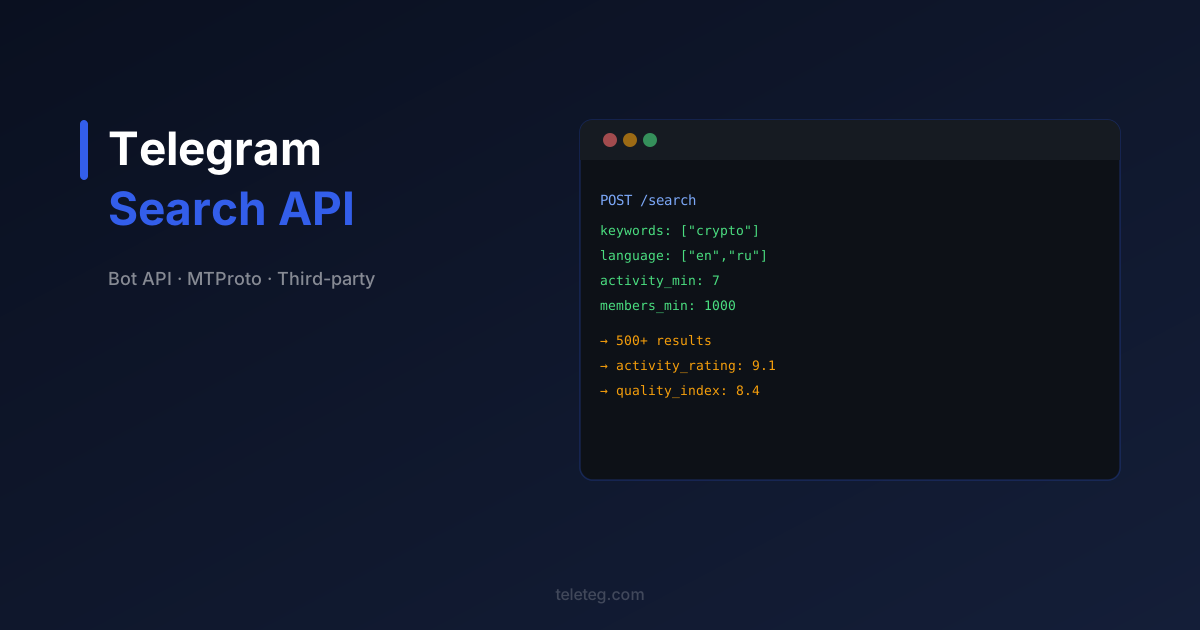
Teleteg and similar services maintain their own indexes of public Telegram communities, built by crawling publicly accessible data over time. They expose this index through a search interface with structured filters — language, activity, member count, creation date — that neither the Bot API nor MTProto natively provides.
What this is good for: discovery and analysis at scale. Finding communities matching specific criteria across millions of indexed channels and groups. Building datasets. Monitoring topics across languages. Anything where you need structured, filterable search results rather than a raw query against Telegram's own index.
Constraints: coverage depends on the service's indexing depth and update frequency. Private communities are largely absent. You are dependent on a third party's infrastructure and data freshness.
Choosing the Right Approach
- Search your own data inside Telegram → Bot API inline queries
- Approximate native Telegram search programmatically → MTProto API with careful rate limit handling
- Discover and analyse public communities at scale with structured filters → third-party indexed service
For most practical discovery and research use cases, the third option produces better results with less infrastructure overhead. The guide to Telegram search databases covers the underlying architecture in more detail.