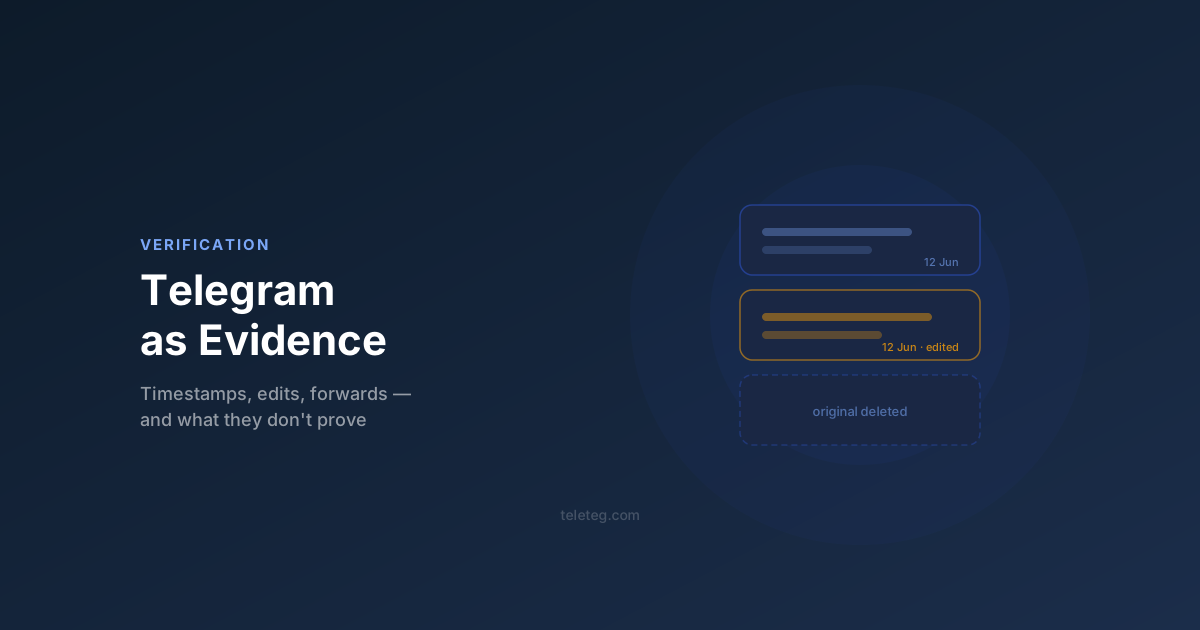
In June 2026, India's National Testing Agency asked for something unusual: not just restricted access to Telegram around a national exam re-sit, but a temporary block on editing messages that had already been posted. The reasoning was specific. Channels had been inserting real exam papers into old messages after the exam finished, then circulating screenshots as proof of a leak that never happened. The timestamp said the post predated the exam. The content had been written afterwards.
That case is narrow. The mechanism behind it is not, and anyone who treats Telegram posts as evidence should understand it.
Edits keep the original date
A channel admin can rewrite any post at any time. The message keeps its original position in the history and its original timestamp. Telegram marks edited messages in the client, but that marker does not survive a screenshot, a forward into a different context, or a re-upload as an image. Nothing in the visible record tells you what the post said when it was first published.
So a screenshot establishes that a post existed at a date. It establishes nothing about what that post contained at that date. For most purposes the distinction does not matter. For anything where the sequence of events is the point — who knew what, and when — it is the whole question.
Forwards are not provenance
The forward header looks authoritative, and it is genuinely useful: it survives deletion of the original, which makes forwards one of the few ways to document a removed channel at all. But it degrades in predictable ways. Operators can disable it. Copy-paste reproduces content with no header whatsoever. A chain of forwards through several chats can put content in front of you with an attribution you have no way of checking, because the source is gone.
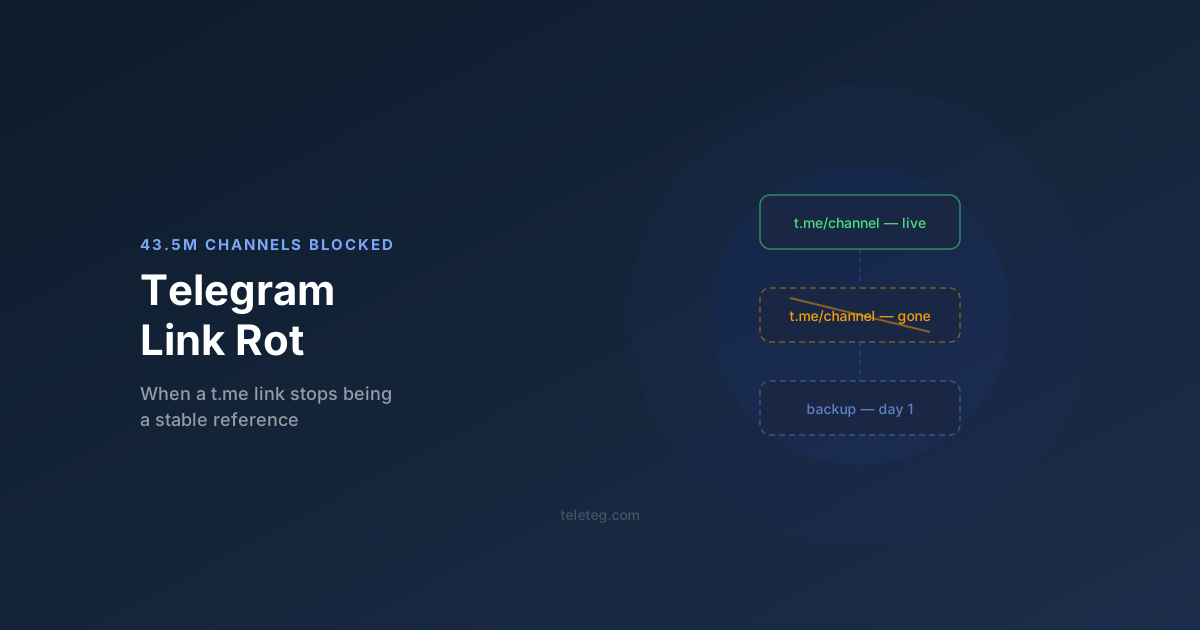
And absence proves nothing in either direction now. With takedowns running at industrial volume, a missing original is the normal state of things rather than a signal — link rot is the default condition, not an anomaly worth remarking on.
A working checklist
- Go to the source, not the screenshot. Open the post in the client. Check for an edit marker. If the original is gone, say so explicitly rather than presenting the screenshot as if it were the post.
- Record the message ID, not just the date. The ID fixes a post's position in the channel's sequence. Sequence is harder to fake than a displayed timestamp.
- Check whether the content fits its neighbours. A post that sits oddly among the messages around it — different register, different subject, suspiciously well-matched to something that happened later — is worth a second look.
- Archive on the day. Capture the post, the surrounding context, and the channel metadata at the moment you find it. Retrospective archiving is not available.
- Corroborate off-platform. One channel is one claim. Two channels forwarding the same claim is still one claim.
Why this is getting harder
Volume works against verification. Rewriting history on a channel used to be a fringe technique; it is now a documented part of how fraud operations build credibility, and it sits alongside the more familiar patterns we catalogued in our write-up on Telegram scams. At the same time the archive is thinning underneath everyone. Between heavy moderation and operators deleting on their own, the window in which a post can be independently checked keeps shrinking.
Waiting a week before looking at something now carries a real chance that there is nothing left to look at.
The short version
Telegram was built as a messenger, not as a public record, and it shows in exactly the places that matter for evidence. Timestamps are display values, not proofs. Forward headers are claims, not chains of custody. Deletion is routine. Treat a Telegram post as a lead that needs verifying rather than a document that speaks for itself — and capture it the day you find it, because the platform makes no promise that it will still be there.