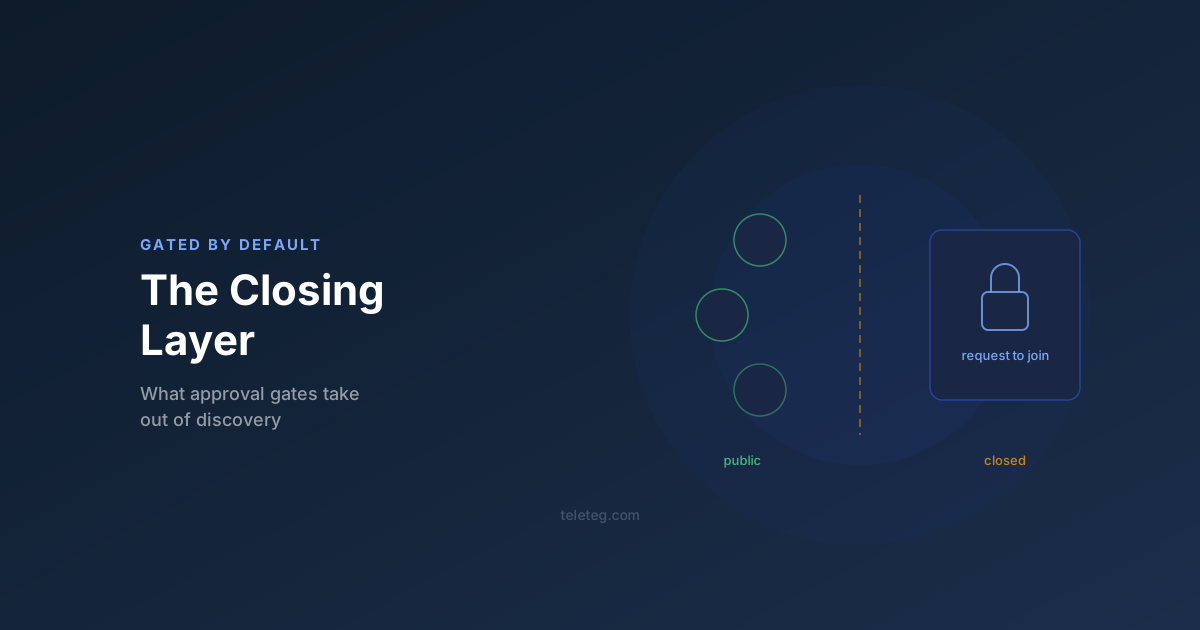
Request-to-join started as a housekeeping feature. Turn it on, and nobody enters your group until an admin approves them. It killed the crude bot floods, and for most operators that was the end of the story.
Then moderation pressure went up sharply, and gating turned into something else. If automated screening cannot see inside your group, your group is much harder to act against — and communities with something to hide worked that out quickly. Threat intelligence teams now list approval gates as one of the standard evasion patterns on the platform. The feature did not change. The reason people use it did.
What gating actually hides
Less than people assume. A gated group still has a username, a title, a description, a photo, and in most cases a visible member count. Its invite link still circulates. Other chats still mention it, still link to it, still forward from it. Members still appear in public chats elsewhere under the same accounts.
What closes is the message history. Everything downstream of that — topic, activity level, tone, who is actually inside — becomes inference rather than observation. For anyone studying a community, that is the difference between reading it and estimating it.
The discovery problem this creates
Telegram has no directory. Discovery has always been assembled from whatever is public, and every group that closes takes a slice of that out of circulation. The effect is uneven in a way that matters: the communities most likely to gate are also the ones most worth finding, so what remains openly searchable skews steadily towards the harmless and the promotional.
For legitimate operators the cost is immediate and usually unintended. Gate a group and you have opted out of organic discovery while keeping every obligation of running one. Growth now depends entirely on the channel that points at it, on mentions elsewhere, and on the description — which most people write once and never revisit, even though it has quietly become the only thing a stranger can read.
Reading a group you cannot enter
The signals that survive are thinner but not useless. A description written for members reads differently from one written for search. Naming conventions repeat across a single operator's projects. Linked chats declare relationships that used to be inferred — something we covered when Telegram started binding groups, channels and bots into single Communities. Member counts move, and the direction tells you whether anything is happening inside.
Recorded history is what makes these signals readable at all. A group that was public for two years and closed last month is a very different object from one that was gated on day one, and you can only tell the two apart if something kept a record of the open period. In-app search shows you the present tense and nothing else.
Where the line sits
Worth saying plainly, because it comes up. Studying what a closed group publishes about itself is ordinary research. Infiltrating it under a false identity, or buying access, is not — it is a different activity with different rules, and in most jurisdictions with different legal exposure. The gate is a stated boundary. There is a lot of legitimate work to be done on the outside of it, and the people who blur that distinction make life harder for everyone doing this properly. Our own guidance on private Telegram groups has not changed on this point.
What operators should take from it
- Gating is a trade, not a setting. You are exchanging discoverability for control. Make that choice deliberately rather than inheriting it from a spam wave two years ago.
- If you gate, the description is your front door. It is the entire public face of the group. Write it for someone who has never heard of you.
- Keep a public entry point. A channel anyone can read, pointing at the gated group, gets you both — visible surface and a controlled room.
The short version
Telegram is splitting into a shrinking open layer and a growing closed one, and the boundary is a single toggle any admin can flip. Discovery tools work on the open layer, so what they see is increasingly a filtered sample rather than the platform. Knowing which parts of your picture are observed and which are inferred is no longer a methodological nicety. It is most of the job.