Teleteg is a public Telegram search engine indexing millions of public channels and groups. This article is part of our knowledge base on Telegram search and community discovery.
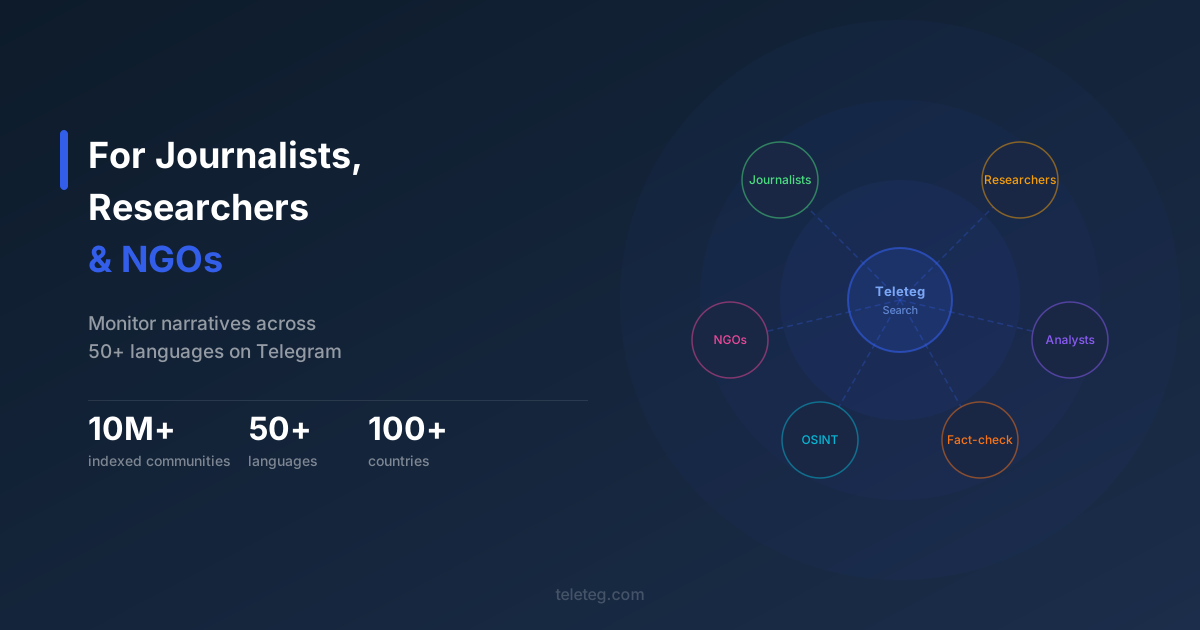
Telegram has become a primary source for anyone tracking how information spreads — from breaking news to coordinated disinformation campaigns. The challenge is that Telegram's sheer scale and fragmentation makes systematic monitoring nearly impossible without the right tools. This guide covers how professionals in journalism, research, and advocacy use Teleteg as part of their workflow.
Monitoring Narratives Across Languages
One of the most common use cases: a story breaks in one linguistic community on Telegram before it reaches mainstream media. By the time English-language sources pick it up, it has been circulating in Russian, Arabic, or Farsi channels for hours or days.
Teleteg's multilingual search makes it possible to monitor a topic simultaneously across language communities. Search for a keyword, apply multiple language filters at once, and sort by activity rating to see which communities are most engaged with that topic right now. This cross-linguistic monitoring is practically impossible to do manually at any meaningful scale.
Mapping Community Structure
For researchers studying how information ecosystems work, understanding the structure of communities around a topic matters as much as the content. Which channels are the largest? When were they founded? How active are they relative to their size? Are there clusters of smaller, highly active communities that the large channels are drawing from?
Teleteg's filters — particularly creation date, activity rating, and member count — make it possible to answer these structural questions without joining each community individually. The result is a map of the landscape that can inform research design or journalistic investigation.
Fact-Checking and Source Verification
When a claim or image starts circulating on Telegram, identifying where it originated requires tracing it back through communities. Searching Teleteg for keywords associated with the claim — combined with a creation date filter to surface communities active around the relevant time — can surface the original source or identify the channels that first amplified it.
The message quality index is useful here: channels that consistently produce original content score differently from those that primarily repost, which helps distinguish primary sources from amplification networks.
NGO and Advocacy Applications
NGOs working on human rights, disinformation, or public health use Teleteg to understand where relevant communities exist before deciding where to engage, monitor, or respond. Understanding the size, activity, and language distribution of communities around a topic is essential groundwork for any advocacy effort that involves Telegram.
The platform also helps identify communities that may be spreading harmful content — not to engage with them directly, but to document their presence and activity for reporting or research purposes.
Academic Research
Researchers building datasets of Telegram communities for quantitative analysis need structured, filterable data. Teleteg's export functionality (available on paid plans) allows results to be downloaded as structured files for further analysis. Combined with the available filters, this makes it possible to define a coherent sample of communities — by language, size, activity level, and creation date — without manual data collection.
Getting Started
The free tier provides enough access to validate a research question or conduct initial landscape mapping. For systematic monitoring or dataset collection, paid plans provide the depth needed. The getting started guide covers the practical steps, and the search tools reference explains every available filter.